

Like the British Council, Alliance Française and Goethe-Institut, DUTCH APPROACH uses the 歐洲語言共同參考框架 (CEFR) as a benchmark for its courses. DUTCH APPROACH has structured its courses around the three CEFR categories: A (Basic User), B (Independent User), and C (Proficient User). Each category is divided into two levels, resulting in six levels in total. For each CEFR level successfully completed, DUTCH APPROACH provides its students with a certificate recognizing their achieved level of Dutch language proficiency.
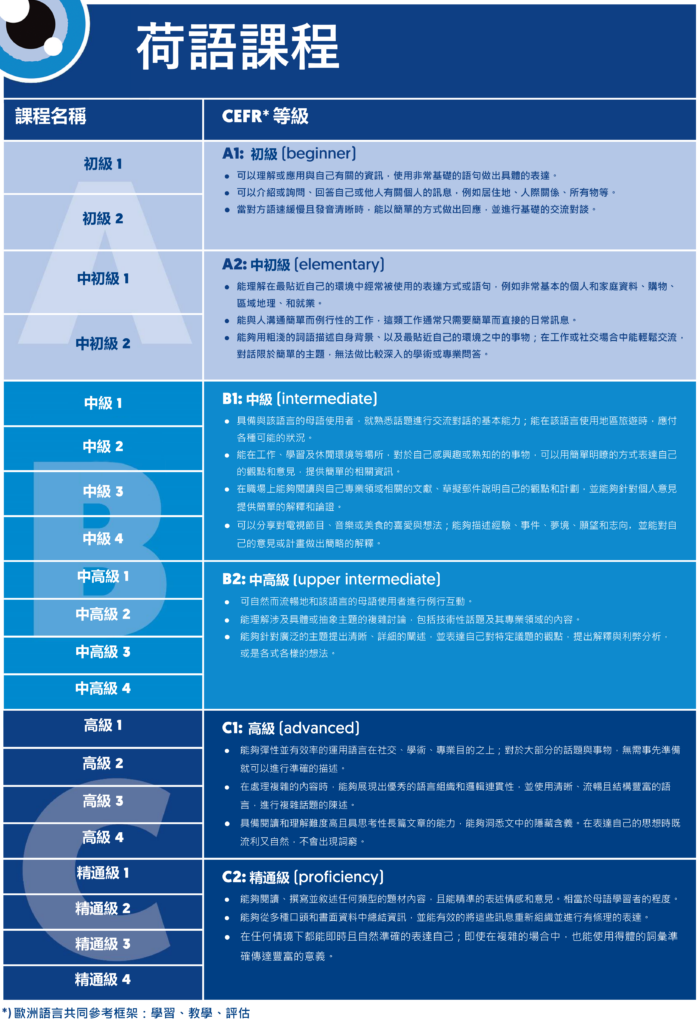
The idea for the CEFR was launched by the Council of Europe in 1991 as part of the project Language Learning for European Citizenship. A first version of the framework was published in 1995, the CEFR was officially launched in 2001. The CEFR provides a common framework for describing the language proficiency of foreign language learners across Europe and beyond. Its main aim is to provide a common basis for language learning, teaching and assessment that can be applied to all European languages, including Dutch. Its six reference levels have since become widely accepted as a European standard for describing and assessing language proficiency.